There's a particular kind of dread that sets in when you're scrolling through a new AI image generator's sample gallery and you spot a brushstroke that feels uncomfortably familiar. Maybe it's the way you render fox fur, or that cross-hatching technique you spent three winters perfecting in your studio off Brick Lane. You can't prove it yet, but your gut says something's off. This article is for that moment, and for the weeks of quiet investigation that should follow it.
We're not solicitors at Forge & Canvas, and nothing here replaces proper legal advice from someone qualified in intellectual property law. What we can offer is a clear-eyed, practical walk-through of how training data actually gets collected, what UK law currently allows, and the groundwork you can lay yourself before any letter goes out or any lawyer gets a call.
How AI models actually gather training images
Most large image generators are trained on datasets scraped from the open web, not from private galleries or locked portfolios. The most commonly cited dataset, LAION-5B, contains over five billion image-text pairs pulled from publicly crawled URLs between 2021 and 2022. It doesn't store the images themselves, it stores links and metadata, but the training process that follows does use the actual pixels at some point in the pipeline.
Scraping bots don't care whether an image sits on your personal site, a stock photo platform, a print-on-demand shop, or a social media post you shared during last year's Open Studios weekend in Walthamstow. If the image was indexable and publicly accessible, it was almost certainly fair game for a crawler. Some platforms, like DeviantArt and ArtStation, have faced direct criticism for how much of their hosted content ended up in these datasets before anyone asked permission.
There's a second route worth knowing about: some companies train on licensed stock libraries or purchased datasets, which muddies the picture further because your work might have entered the pipeline through a stock agency contract you signed years ago, not through scraping at all. Reading the small print on any stock licensing agreement before you upload new work is worth ten minutes of your evening.
- Common entry points for scraped artwork: personal portfolio sites, art marketplaces, social platforms, forum posts, and auction archives
- Less obvious entry points: stock photo libraries, print-on-demand catalogues, museum digitisation projects, and old blog posts with embedded images
- What usually isn't scraped: work behind paywalls, private cloud storage, password-protected galleries, and images with no accessible direct URL
What UK copyright law currently says
Under the Copyright, Designs and Patents Act 1988, you own copyright automatically the moment you create an original work, no registration required. That protection generally runs for your lifetime plus seventy years. In principle, reproducing your work without permission, including copying it into a training dataset, could count as infringement.
The complication is the text and data mining exception. UK law currently permits text and data mining for non-commercial research without a licence. Commercial AI training sits in a greyer zone, and the government has been actively consulting on whether to widen this exception to cover commercial uses too, a proposal that provoked strong pushback from illustrators' and photographers' bodies through 2023 and 2024.
As it stands in early 2025, there is no settled UK case law that definitively rules on whether training a commercial model on scraped copyrighted images constitutes infringement. The Getty Images v Stability AI case, heard in the UK courts, is one to watch closely, since its outcome could shape how these claims are treated for years. Until there's a clear ruling, individual artists are largely navigating untested ground.
| Situation | Current UK legal position |
|---|---|
| Non-commercial academic text and data mining | Permitted without a licence under existing exception |
| Commercial AI training on scraped images | Legally contested, no definitive ruling yet |
| Work used without attribution in AI output | Possible moral rights issue, case-by-case basis |
| Licensed stock work used for training | Depends entirely on the original licensing terms |
Checking whether your work has been scraped
Start with Have I Been Trained, a search tool built by Spawning that lets you check whether specific images of yours appear in the LAION-5B or LAION-400M datasets. Upload a piece or search by your name, and it will return visual matches if they exist. It's not comprehensive, since plenty of other datasets exist outside LAION, but it's the most accessible starting point most artists have right now.
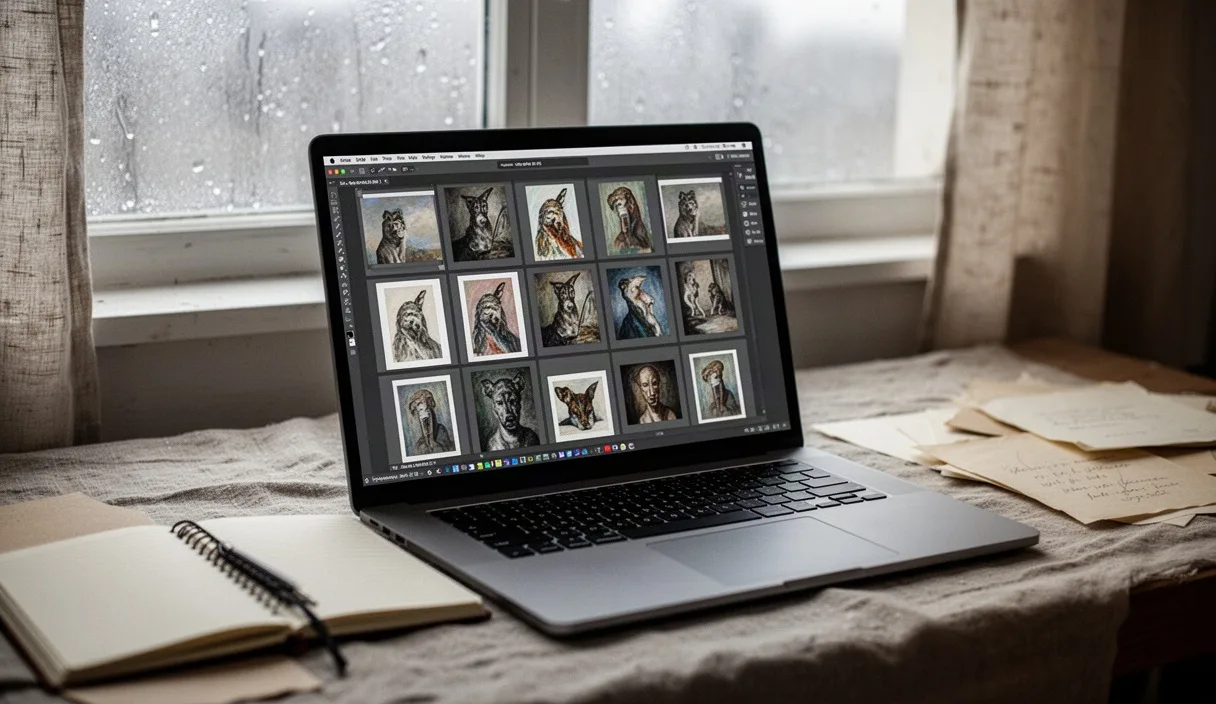
Next, try reverse image searches through Google Images and TinEye on your most distinctive, most-shared pieces. Look specifically for AI-generated images that echo your compositional habits, your palette choices, or recurring motifs, not just direct copies. A generated image rarely matches pixel for pixel, it mimics style, which makes this detective work slower and less conclusive than you'd like.
Some artists have had luck prompting generators directly with phrases like "in the style of [your name]" to see what comes back. If a model produces output eerily close to your known body of work using your name as a prompt trigger, that's a meaningful data point, though it's circumstantial rather than proof of scraping.
Keep a simple log as you go: date checked, tool used, what you found, screenshots saved. This habit matters more than it seems in the moment, and we'll get to why in the next section.
Documenting your case before you contact anyone
Before you fire off an angry email to a platform's support inbox, build a file. Think of it the way you'd think of insuring a print run, boring until the day it saves you.
- Save dated originals: file metadata, EXIF data where available, and any timestamped upload history from your own site or socials
- Screenshot everything: the Have I Been Trained results, reverse image search matches, generated outputs that resemble your work, with visible dates and URLs
- Record provenance: sketches, process shots, early drafts, anything proving the work existed in your hands before it existed online
- Note publication history: where and when each piece was first posted, sold, or exhibited, including gallery show dates if relevant
- List any licensing agreements: stock contracts, commission terms, print-on-demand platform agreements that might explain how the image travelled
This isn't paranoia, it's the same discipline printmakers already use when registering editions or photographers use when watermarking proofs. The difference is you're building a paper trail for a dispute that might take months to resolve, not days.
Who to contact first, platform or model maker
Most artists' instinct is to go straight to the AI company. In practice, the platform where your work was originally hosted is often the faster, more responsive first stop, particularly if that platform has a DMCA takedown process or an opt-out mechanism for AI training.
DeviantArt, for example, introduced a "noai" meta tag that site owners and artists can add to prevent future scraping, alongside opt-out settings in account preferences. ArtStation added similar "NoAI" labelling after artist backlash in late 2022. These won't retroactively remove your work from datasets already compiled, but they're worth activating immediately to stop the bleeding.
Contacting the model maker directly is the harder, slower route. Stability AI, OpenAI, and Midjourney all have opt-out request forms or contact channels, but response times vary wildly and removal from a dataset doesn't necessarily mean removal from a model already trained on that data. Think of it like asking someone to forget a conversation they've already had, the dataset entry might go, but the learned patterns can persist.
If you believe you have a genuine infringement claim rather than just a scraping concern, that's the point to consult an IP solicitor rather than continuing DIY efforts. Several UK firms now offer initial consultations specifically for creative professionals dealing with AI-related disputes, and getting proper advice before sending a formal letter matters more than sending something quickly.
Where this debate is likely headed next
The UK government's consultation on AI and copyright, which closed in early 2024, floated three broad directions: expanding the text and data mining exception to cover commercial use, requiring opt-out mechanisms as standard, or mandating licensing schemes for training data. No final policy had been settled at the time of writing, and the political pressure from creative industries, including the Design and Artists Copyright Society, has been loud and sustained.
Meanwhile, the EU's AI Act has pushed transparency requirements that could eventually ripple into UK practice, requiring model makers to disclose summaries of copyrighted material used in training. Whether the UK adopts anything similar post-Brexit remains an open question, but it's one worth watching if you exhibit or sell internationally.
Collective licensing models, similar to how music royalties work through PRS for Music, have been proposed by various artist advocacy groups as a middle path, letting creators opt in and get paid rather than simply opting out and getting nothing. Nothing concrete has launched at scale yet, but a few smaller licensing pilots have started appearing from stock agencies keen to monetise their archives for AI training legitimately.
Common mistakes
Artists chasing this issue tend to trip over the same handful of errors. Sending a cease and desist letter before consulting a solicitor can weaken your position if the wording overreaches what you can actually prove. Assuming a single reverse image match is conclusive evidence of scraping, when style similarity alone rarely holds up as proof. Forgetting to screenshot evidence before a platform updates its gallery or a generator's sample outputs rotate, which can erase your record overnight. And treating an opt-out tag as retroactive protection, when it only prevents future scraping, not removal from existing datasets.
Practical next steps
Start small and methodical this week: run your five most distinctive pieces through Have I Been Trained and a reverse image search, and save whatever you find whether it's alarming or reassuringly empty. Add opt-out tags to any platform profile that offers them, even if you're not sure anything's been scraped yet, since it costs nothing and closes a door going forward.
If you find something that genuinely concerns you, resist the urge to post about it publicly before you've built your documentation file. Book a consultation with an IP solicitor who has handled creative sector cases, many offer a fixed-fee initial assessment, and bring your evidence log rather than just your frustration. This is a slow-moving legal landscape, closer to watching paint cure than watching it dry, and the artists who come out of it with the strongest position will likely be the ones who kept quiet, methodical records rather than the ones who shouted first.