Walk through any open studio weekend this autumn and you'll notice something new taped next to the price tags: a few extra lines about process. Not the usual "oil on canvas, 2024" shorthand, but a sentence or two about whether a laptop had a hand in the composition before the brush did. It's a small addition, but it's changing how buyers linger at a table, and how jurors read an entry form at the community center. This guide is written for working artists, the kind who sell at the Saturday market, submit to the mill district's winter show, or hang work in the co-op gallery above the hardware store. It won't tell you whether using AI is right or wrong. It will tell you how to talk about it plainly, where to put that information so people actually see it, and what tends to go wrong when artists either overshare or say nothing at all.
Why disclosure has become a live issue at local shows
Three years ago, nobody asked about process at the fall open studios. Now at least one juror on every panel asks it directly, because entries have arrived with AI-generated reference images, AI-upscaled prints, and in a few cases, fully AI-composed pieces printed on canvas and framed like paintings. The co-op gallery changed its entry form last spring to include a yes-or-no checkbox: "Did you use generative AI tools in creating this work?" It's not a rejection trigger. It's there so the hanging committee can group and label honestly.
The shift has practical roots. A regular at the mill district show submitted a piece that turned out to be a Midjourney output she'd touched up with watercolor glazes. When a buyer later asked about her brush technique in the sky, she had to explain there wasn't one, not in the way the buyer assumed. The sale went through, but the conversation was awkward for both of them. That kind of moment, repeated a handful of times across a season, is what pushed organizers to standardize the question rather than leave it to chance.
There's also a simple matter of fairness among exhibitors. Entry fees, booth rents, and judging categories were built around assumptions of hand labor. When some pieces take forty hours of studio time and others take forty minutes of prompting plus printing, show organizers are trying to figure out whether those belong in the same category at all, the same way a county fair separates canned goods from store-bought preserves.
What viewers and buyers actually want to know
Buyers at a craft fair rarely ask about AI in the abstract. They ask specific questions, and your statement should answer the ones that come up most:
- Did a machine generate the image, or did you generate reference material and then paint, draw, or build the final piece by hand?
- If AI was involved in the final output, how much editing, compositing, or physical work happened after that point?
- Is this a one-off, or can the exact image be regenerated and printed again, affecting how "original" the piece really is?
Buyers at the higher end of the market, the ones spending three or four hundred dollars at a gallery opening rather than thirty dollars at a craft table, tend to ask the second and third questions explicitly, because they're thinking about resale and about what they're actually paying for. A clear statement answers this before they have to ask, which keeps the conversation about the work instead of about your tools.
Jurors and gallery staff want something slightly different: a consistent, truthful answer they can rely on for labeling and for category decisions. A juror at the winter show told me she doesn't care how an artist used AI, she cares that the answer on the entry form matches what's actually true, because mismatches are what create disputes after ribbons are awarded.
Three example statements from open studio events
These are adapted from real statements seen at local shows this past season, trimmed for length but kept close to the original wording and tone.
| Artist's approach | Statement language used | Why it works |
|---|---|---|
| Hand-painted from AI-generated reference | "I used an AI image generator to explore composition ideas, then painted this piece entirely by hand in oil over twenty-two hours." | Names the tool's role, gives a concrete hand-labor detail that answers the unspoken question about effort. |
| AI-composed, then heavily reworked digitally | "The base image was generated using AI, then I spent roughly fifteen hours editing color, texture, and composition in Photoshop before printing." | Separates the two stages and gives a time estimate, so buyers can judge the balance of machine and human work. |
| Fully AI-generated, printed as-is | "This print was generated using AI tools from a text prompt I wrote, with no further manual editing. Edition size: 1 of 15." | No hedging, and includes edition size, which matters for resale value and is often the first follow-up question. |
Notice none of these statements apologize or oversell. They read the same way a woodworker might note "kiln-dried white oak, hand-joined" or a potter might note "wheel-thrown, wood-fired." The goal is description, not defense.
Where to place the disclosure so it's not missed
A disclosure buried in the third paragraph of a long artist biography might as well not exist. At the farmers market art tent last July, two artists had AI disclosures in their written statements, but both were folded inside a laminated sheet nobody picked up. Buyers found out by asking, which defeats the purpose of writing it down at all.
Practical placement options, roughly in order of visibility:
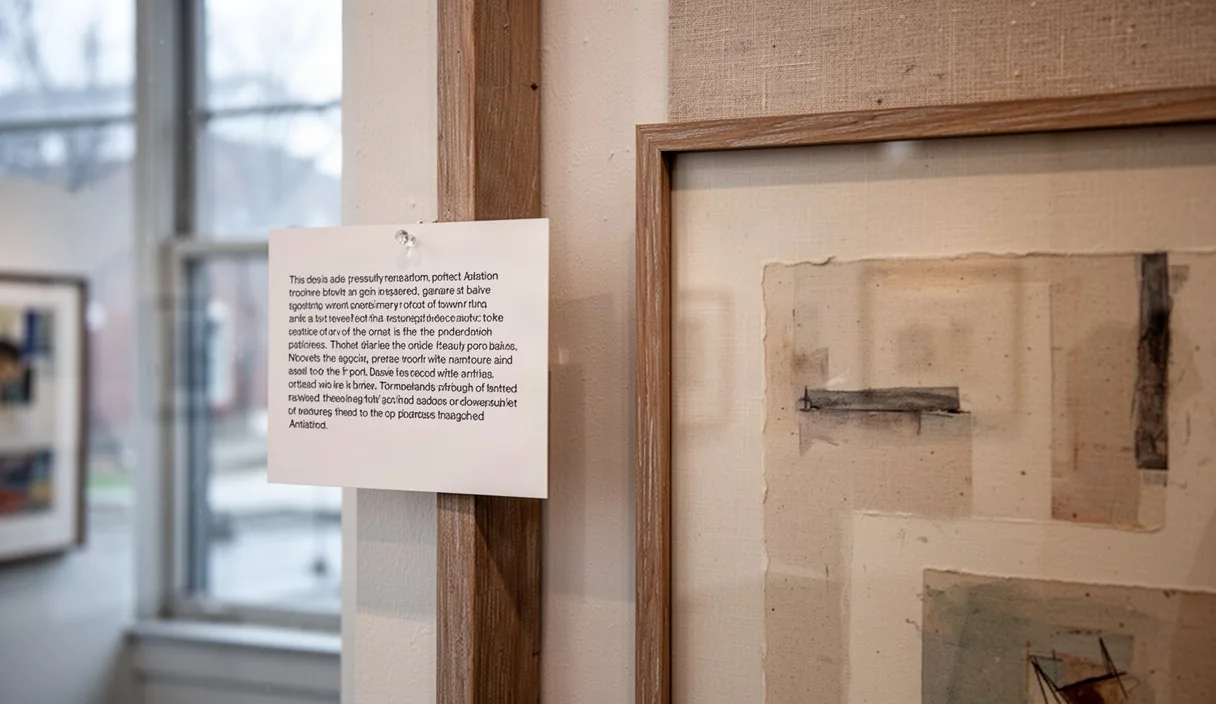
- On the price tag itself, as a short line under the medium ("Mixed media, AI-assisted reference").
- On a small table card next to each piece, separate from your general bio card.
- In the first two sentences of your artist statement, not the last paragraph.
- On your entry form for juried shows, in the dedicated field if one exists.
If you sell online through a shop or a local co-op's website, the same rule applies: put it in the listing description itself, not in a separate "about the artist" page that most buyers skip. One frame shop downtown now stamps a small "AI-assisted" tag on the back of any piece that qualifies, a habit borrowed from how they've long marked giclée reproductions versus originals.
Updating old statements for older work
If you made work two or three years ago, before this became a standard question, you likely don't have a disclosure attached to it at all. You have a few options, and none of them require rewriting history.
For work still in inventory or available for sale, add a short retroactive note rather than rewriting the original statement: "Note added 2024: this piece's background elements were generated using AI tools available at the time." This keeps your original voice intact while bringing the listing up to current expectations. It's the same approach a gallery might use when relabeling an older piece whose materials list was incomplete.
For a body of work spanning several years with inconsistent tool use, consider a single standing statement on your website or artist page that explains your general practice over time, with specific pieces flagged individually where the practice changed. This avoids writing fifteen separate disclosures and instead gives one honest overview, updated as needed.
If you're unsure how a specific gallery or show wants retroactive disclosure handled, especially for pieces already sold, it's worth asking the organizer directly rather than guessing. Some have no policy yet and will appreciate you raising it.
What happens if you say nothing
Saying nothing isn't neutral, even if that's how it feels in the moment. At a minimum, it shifts the burden onto the buyer or juror to ask, and many won't, they'll just form an assumption and act on it. That assumption is usually that the work is entirely hand-made, since that remains the default expectation at most local shows.
The practical risk shows up later rather than immediately. A buyer who finds out after purchase that a piece was AI-generated, when they'd assumed otherwise, tends to feel misled even if no one lied outright, simply because the omission did the misleading for them. One gallery in the district quietly stopped carrying an artist's prints last year after exactly this situation, not because of a policy violation, but because the gallery owner felt blindsided in a conversation with a client.
For juried shows specifically, omission can have a harder consequence: disqualification after the fact if the entry form asked directly and the answer given was incomplete or false. This isn't a legal matter in most cases, it's a show-organizer decision, but if you're dealing with a dispute over a sale, a commission, or a contract that involved misrepresentation, that's a point where talking to a lawyer makes more sense than relying on general guidance like this.
Common mistakes
A few patterns show up again and again at local shows and in online shops:
- Vague language like "digitally enhanced" that could mean anything from color correction to full AI generation, leaving buyers to guess.
- Disclosure written once in a long bio and never repeated near the actual piece or listing.
- Treating disclosure as a confession rather than a material description, which makes buyers more suspicious, not less.
- Forgetting to update disclosure language when your process changes between bodies of work.
Next steps for your own statement
Start small: pick one current piece that involved AI at any stage, and write a single honest sentence describing exactly what happened, the way you'd describe a glaze or a joinery method. Use that sentence as your template for every other piece, adjusting the specifics rather than the tone.
Then check where that sentence actually appears, on the tag, the table card, the online listing, and the entry form, not just in a statement tucked in a binder nobody opens. If you show regularly at the same two or three venues, ask the organizers directly whether they have a disclosure policy yet. Several don't, and your question might be the one that gets them to write one, the same way that one artist's awkward sale conversation at the mill district show got the co-op to add its checkbox.